Support polygon basics
The three contact patches form a triangle, and tipping starts when the rider's weight, pushed sideways in a turn, crosses one of its edges. Sitting inside the wide part of that triangle is worth more than any accessory.
choosing, buying and maintaining three-wheeled adult cycles, both pedal-only and electric-assist
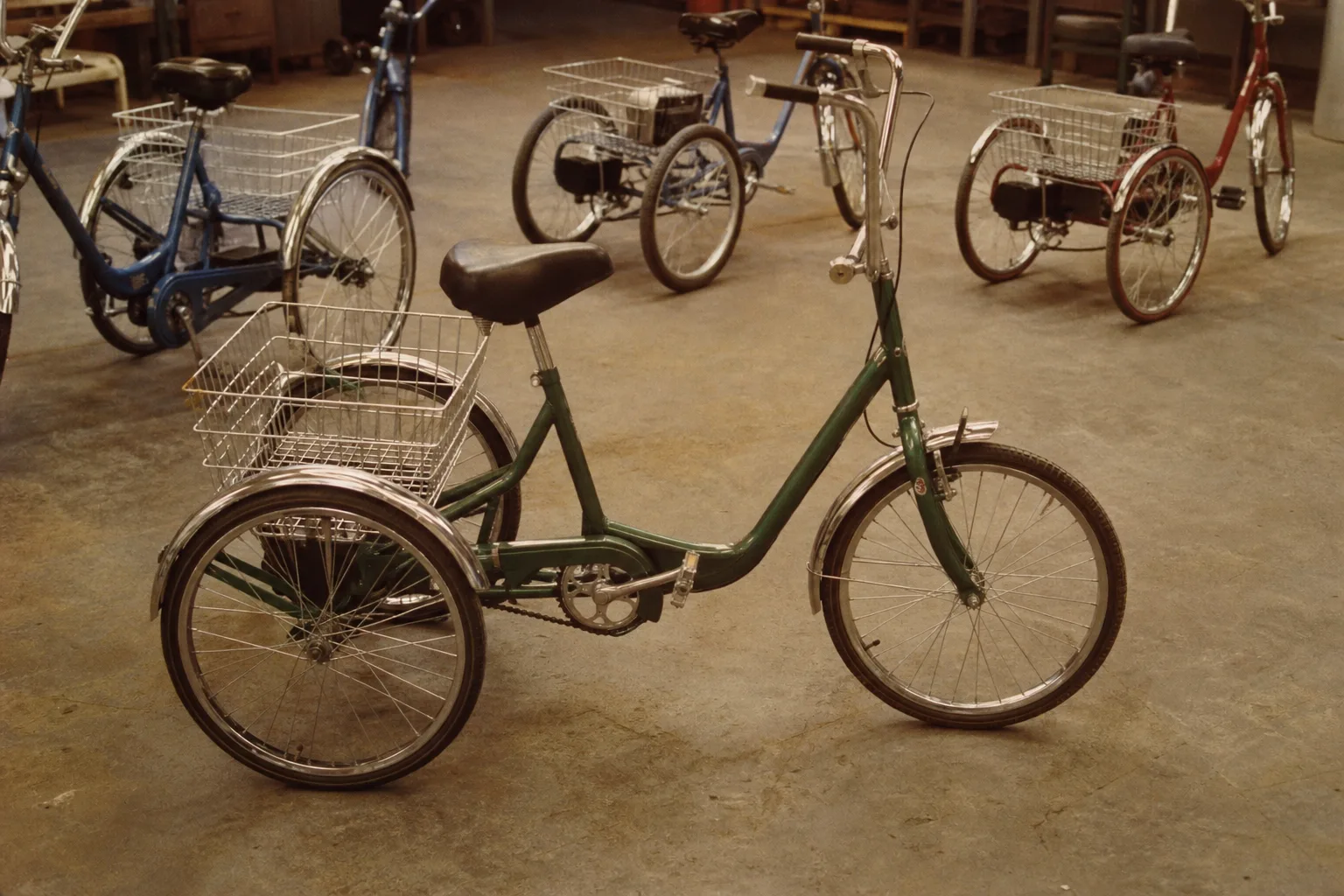
A tadpole has two wheels in front and one behind; a delta has one in front and two behind. The rest of the handling difference follows from that arrangement.
Two wheels in back and one in front is a tadpole. One wheel in back and two up front is a delta. That single difference sets almost everything else about how the machine behaves: where the stable triangle sits relative to the rider, how far the frame can lean into a corner before something lifts, how tight the turn gets before the inside wheel goes light, and how much a manufacturer has to spend on drivetrain hardware to make the thing work. A careful buyer can predict most of it from the spec sheet, before ever sitting on one.
Draw a line between the three contact patches and you have the support polygon. Tip-over begins when the center of gravity, projected downward under cornering load, crosses one of those lines. On a tadpole, the wide pair is in front and the rider sits well behind the front axle, close to the middle of the triangle, low in a reclined seat. On a delta, the wide pair is behind and the rider sits forward of it, near the narrow apex, usually upright and higher. The tadpole rider is inside the strongest part of the shape. The delta rider is near the weakest.
That is the whole argument in one paragraph, and it explains the pattern reported by riders and by shops that take trade-ins: deltas lift the inside rear wheel earlier in a turn, and tadpoles lift an inside front wheel later and with more warning through the steering. The Consumer Product Safety Commission is the federal body responsible for bicycle safety requirements in the United States, and any trike sold here should meet the applicable requirements regardless of layout, but no standard tells you how a given frame behaves on an off-camber driveway.
Track width is the distance between the centers of the paired wheels, and it is listed on most decent spec sheets. Common adult trikes run somewhere in the low-to-mid thirties of inches, and a few touring tadpoles go wider. Seat height, measured from the ground to the lowest part of the seat pan, is the other half. A tadpole with a seat pan in the single digits or low teens of inches and a track in the low thirties is a fundamentally different object from a delta with a saddle roughly two and a half feet up and a similar track, even though the two look comparable on paper until you put the numbers side by side.
The useful ratio is seat height divided by half the track. Smaller is better. A tadpole at ten inches of seat height on a thirty-two inch track gives roughly 0.63. A delta at thirty inches of seat height on the same track gives roughly 1.88, three times worse, and that ratio moves in direct proportion to the lateral acceleration each machine will tolerate. It is a rough model, since the rider's mass sits above the seat and the frame contributes its own weight low down, but as a way of ranking two candidates it holds up well.
Deltas usually turn tighter, because the single steered wheel has nothing beside it to collide with and many designs allow a large steering angle. Tadpoles are constrained by the two front wheels and their linkage, and turning circles in the fifteen to twenty foot range are typical. The tight delta turn is genuinely useful in a garage or on a narrow trail, but tightening the radius at a given speed raises lateral load, so the layout that turns tightest is also the one that runs out of grip on the inside wheel soonest. Slow down before the turn, not during it.
Camber compounds this. A crowned road or a sloped driveway apron effectively tilts the support triangle, and the delta, sitting high and narrow at the front of its own triangle, feels it first. A tadpole simply tracks across and the rider notices little. Riders who spend most of their miles on cambered shoulders should weight this heavily; riders on flat rail-trails and paved paths can weight it much less, and either layout serves well.
Deltas win on mounting. A step-through frame with an upright saddle at roughly hip height means stepping over a low tube and sitting down. Tadpoles ask the rider to lower into a reclined seat a few inches off the ground and stand back up from it, which suits people with good knee and hip function and frustrates those without. Price runs the other way. Deltas often need a differential or a driven single wheel and cost less to build, while tadpoles carry two steering knuckles, tie rods, and a long chain run, and generally start higher. Test both, on the surfaces you actually ride.
The three contact patches form a triangle, and tipping starts when the rider's weight, pushed sideways in a turn, crosses one of its edges. Sitting inside the wide part of that triangle is worth more than any accessory.
Track width is the center-to-center distance between the paired wheels and is usually published. Most adult trikes fall in the low to mid thirties of inches, and a wider figure is meaningfully more forgiving.
Measure from the ground to the lowest part of the seat pan, not to the top of the cushion. A reclined tadpole seat can sit near ten inches while an upright delta saddle sits near thirty.